PM Modi calls for swift end to West Asia, Ukraine conflicts



India, Finland sign 11 major outcomes during Finnish President's visit as ties elevate to ‘Strategic Partnership in Digitalisation Sustainability’
06/03/2026
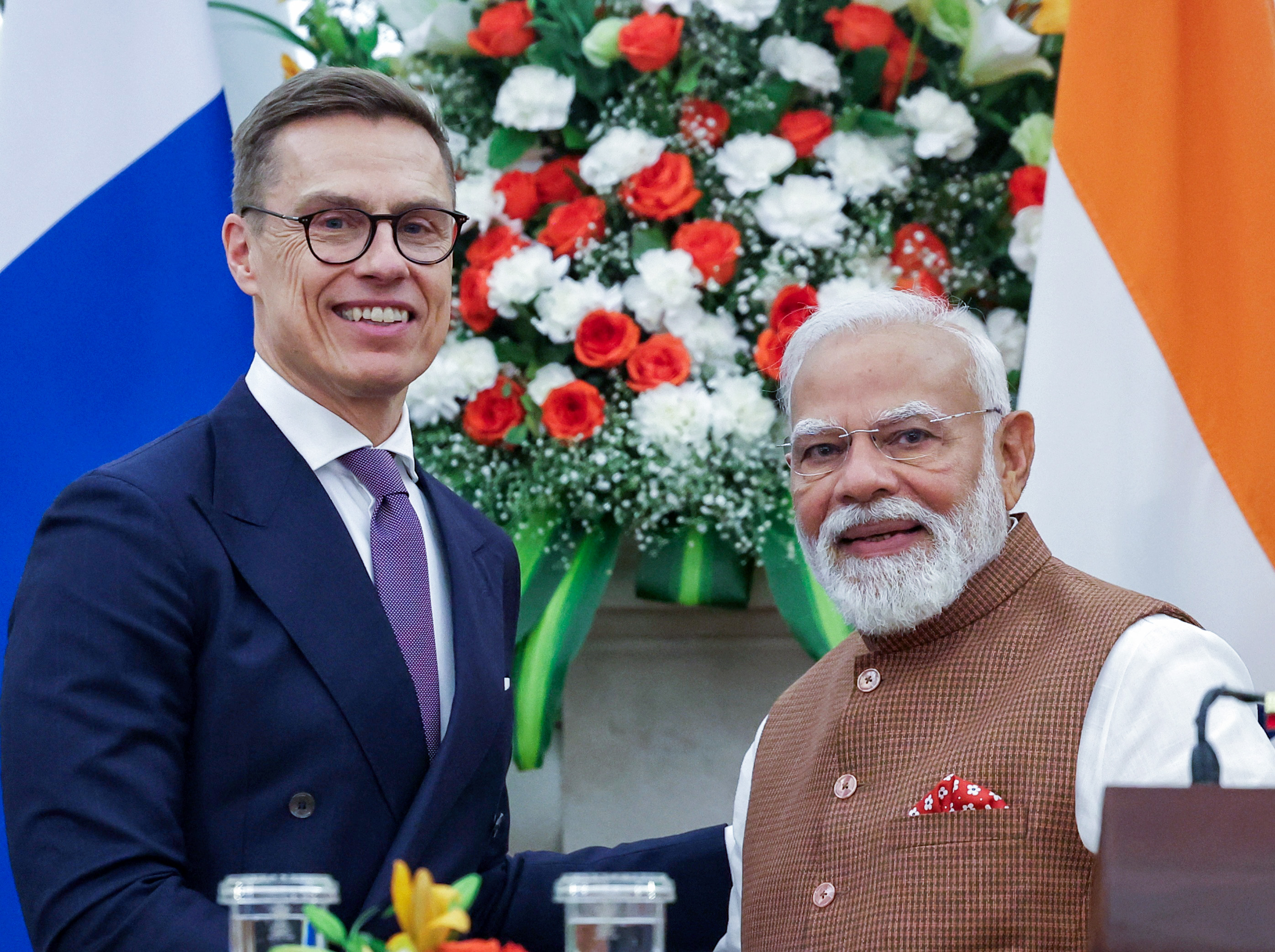
NEW DELHI, Mar 5: With West Asia on the brink of a wider regional war, Prime Minister Narendra Modi on Thursday called for a "swift end" to the escalating confrontation in the region saying no issue can be resolved solely through military conflict.
Modi's remarks following his wide-ranging talks with Finnish President Alexander Stubb came as the United States and Israel's war with Iran entered the sixth day with both sides launching fresh strikes, significantly heightening tensions across the region.
Stubb strongly backed India's bid for a permanent seat at the United Nations Security Council, arguing that it is of "utmost importance" along with larger reform of the global multilateral system to reflect the current geopolitical realities.
Following the Modi-Stubb talks, the two sides elevated their bilateral relations to "Strategic Partnership" in digitalisation and sustainability and vowed to double annual bilateral trade by 2030.
India and Finland also signed three agreements including one on migration and mobility that will facilitate mobility of Indian talents to the European nation.
In his media statement, Modi said the India-Finland strategic partnership in the digitalisation and sustainability will energise cooperation in many high-technology areas including AI, 6G telecom, clean energy and quantum computing.
The two sides also agreed to deepen cooperation in key sectors such as defence, space, semiconductors, and critical minerals.
The crisis in West Asia figured prominently in the Modi-Stubb talks.
"India and Finland both believe in the rule of law, dialogue, and diplomacy. We are in agreement that no issue can be resolved solely through military conflict," Modi said.
"Whether in Ukraine or in West Asia, we will continue to support every effort aimed at the early end of conflict and the restoration of peace," he said.
The prime minister also made a mention of the upswing in India-Europe relations.
"Today, the world is passing through a phase of instability and uncertainty. From Ukraine to West Asia, several parts of the world continue to face situations of conflict. In such a global environment, India and Europe, two major diplomatic powers of the world, are entering a golden phase in their relationship," he said.
"Our growing cooperation is imparting new strength to global stability, development, and shared prosperity."
The Finnish president said both sides deliberated on the conflict in West Asia and Russia's "war of aggression" against Ukraine.
"We agreed that ending the war is in everyone's interests. A lasting peace can only be one that respects the principles of the United Nations," he said.
In his remarks, Modi said the India-European Union free trade agreement will help deepen ties between New Delhi and Helsinki.
"This agreement will further strengthen trade, investment, and technology cooperation between India and Finland. India and Finland are important partners in areas such as digital technology, infrastructure, and sustainability," he said.
The prime minister also highlighted Finnish telecom giant Nokia's operations in India.
"Nokia's mobile phone and telecom networks have connected millions of Indians. In collaboration with Finnish architects, we built the world's tallest railway bridge over the Chenab river," he said.
"Inspired by such significant examples, we are transforming India-Finland relations into a strategic partnership in digitalisation and sustainability during President Stubb's visit," Modi said.
"This partnership will accelerate and energize our cooperation in many high-tech areas, from AI to 6G telecom, from clean energy to quantum computing," he said.
Modi said both sides will also deepen partnership in key sectors such as defence, space, semiconductors, and critical minerals.
"This strategic partnership between democratic and responsible countries like India and Finland will contribute to ensuring trustworthy technology and supply chains for the entire world," he said.
"Finland is an important partner of India in the Nordic region. Together with Finland, we are also increasing cooperation in Arctic and polar research," he said.
Modi and Stubb also reiterated their shared commitment to promoting a free, open, peaceful and prosperous Indo-Pacific, in accordance with international law.
Both the leaders also unequivocally condemned terrorism and violent extremism in all its forms including cross-border terrorism.
"They called for decisive and concerted international efforts to combat terrorism in a comprehensive and sustained manner and in accordance with international law," a joint statement said.
"They agreed to enhance cooperation to counter violent radicalization and extremism, combat financing of terrorism, promote internationally agreed anti-money laundering standards, prevent exploitation of new and emerging technologies for terrorist purposes, and tackle terrorist recruitment," it said.
Meanwhile, India and Finland on Thursday marked a major milestone in their bilateral ties by elevating relations to a "Strategic Partnership in Digitalisation and Sustainability", with both countries agreeing on a series of initiatives covering trade, technology, mobility, sustainability, and innovation.
The announcement was made during the state visit of Finnish President Alexander Stubb to India, coinciding with his role as Chief Guest at the 11th Raisina Dialogue.
During the visit, the two countries signed an MoU on Migration and Mobility Partnership, which will facilitate the movement of Indian professionals to Finland, particularly in the technology and innovation sectors.
The leaders also renewed the existing MoU on Environmental Cooperation, expanding collaboration in areas such as bioenergy, waste-to-energy solutions, green hydrogen, power storage, and renewable energy systems, including wind, solar, and small hydropower.
In addition, an MoU on cooperation in the field of statistics was signed to enable the exchange of best practices and mutual collaboration in official statistics.
The state visit also saw announcements aimed at boosting bilateral cooperation, including the launch of joint research initiatives under an implementation arrangement between India's Department of Science and Technology and Finland's Innovation Funding Agency, Business Finland.
Both sides also expressed their aim to double bilateral trade by 2030, leveraging opportunities created by the recently concluded India-EU Free Trade Agreement.
Efforts to strengthen cooperation in emerging technologies were also agreed upon, with the establishment of a cross-sectoral Joint Working Group on Digitalisation, the creation of a Joint Task Force on 6G, and enhanced connectivity between startup ecosystems through the Indo-Finland Startup Corridor.
India and Finland will also co-host the World Circular Economy Forum in 2026 and set up a Consular Dialogue between their foreign ministries to further streamline cooperation.
Following his meeting with the Finnish President, Prime Minister Narendra Modi, in a post on X, stated that the talks with Stubb were wide-ranging, covering trade, technology, infrastructure, defence, space, AI, semiconductors, education, and mobility.
He added that the Migration and Mobility Agreement would provide new momentum to the partnership, while cooperation in Arctic and polar research was also discussed.
"We see great scope in working together to ensure trustworthy technologies and resilient supply chains for the entire world. The Migration and Mobility Agreement will add momentum to our partnership. We are also expanding our cooperation in Arctic and polar research," the Prime Minister stated in his post.
The Ministry of External Affairs (MEA) in a post on X also stated that both leaders reaffirmed their commitment to deepen collaboration across trade, investment, digitalisation, clean energy, circular economy, technology, education, innovation, and people-to-people ties, while also promoting multilateral cooperation and joint efforts against terrorism.
"In a major milestone, the leaders agreed to elevate India-Finland relations to "Strategic Partnership in Digitalisation and Sustainability". The two leaders reaffirmed their commitment to broaden and deepen cooperation in the areas of trade & investment, digitalisation & sustainability, clean energy & circular economy, semiconductors & critical minerals, education & innovation, technology, including AI, 6G, quantum computing and mobility & people-to-people ties. Both leaders reiterated their shared commitment to eradicate terrorism in all its forms," the MEA stated.
"Prime Minister Modi highlighted India's initiatives in digital transformation, skilling, and ease-of-doing business, and invited enhanced Finnish participation in India's flagship programmes. The leaders also exchanged perspectives on regional and global issues of concern. They agreed to advance cooperation in the multilateral fora as well," it added.
President Stubb thanked PM Modi for the warm welcome and highlighted that India is a key partner for Finland, noting that the newly signed EU-India Free Trade Agreement would open new avenues for trade, economic collaboration, science, and innovation.
"Thank you for the warm welcome to India, Prime Minister Narendra Modi. India is an important partner for Finland. The state visit will further deepen our cooperation in the fields of trade, the economy, science and innovation. The newly signed EU-India Free Trade agreement opens new opportunities for both countries," the Finnish President said in a post on X.
The visit and the agreements reached signal a comprehensive strategic vision for India-Finland relations, emphasising collaboration in digitalisation, sustainability, innovation, and technology, while creating a roadmap to expand bilateral trade, talent mobility, and joint research over the coming decade.
Share This Story |
|
Comment On This Story |
|
|
|
|