India-UK FTA historic moment, needs robust ADR architecture: CJI Surya Kant



06/06/2026
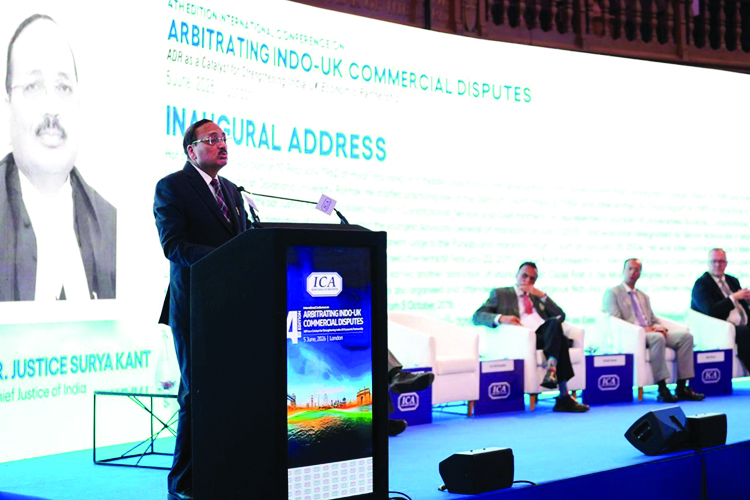
New Delhi, Jun 5: Terming the India-UK free trade agreement an unquestionably historic moment for both nations, Chief Justice of India Surya Kant on Friday stressed the need for a robust alternate dispute resolution (ADR) architecture that converts commercial confidence into day-to-day practice.
Speaking at the fourth edition of the international conference on 'Arbitrating Indo-UK Commercial Disputes' organised by the Indian Council of Arbitration in London, CJI Kant said it must be ensured that arbitration is not a privilege of scale, but an instrument of justice.
He said contemporary international arbitration asks parties for a profound act of trust, and when they step away from their national courts and submit their dispute to a private tribunal, they are entitled to expect a process that is fair, proportionate and timely. "Just last year, the India-UK free trade agreement (FTA) was concluded, which was an unquestionably historic moment for both nations. Because at a time when international trade discourse was marked by strain and uncertainty, India and the UK showed the world a better way forward.
"The FTA is expected to increase bilateral trade between the two nations by an estimated USD 34 billion a year by 2040, an aspiration of extraordinary ambition," he said.
The CJI also said that ambitions are realised in contracts, not communiques, and the India-UK economic partnership cannot be strengthened by trade agreements, tariff schedules and investment announcements alone. "It also needs an ADR architecture that converts commercial confidence into day-to-day practice. And it is that apprehension of the structural failures I have just described that stand most directly between the aspiration of the FTA and the commercial reality it is meant to enable," he said.
CJI Kant, who is on a six-day trip to the UK, said that if arbitration becomes too expensive, too slow, too closed, or too formal for the parties it is meant to serve, the institution must look within.
Highlighting the structural challenges faced by international arbitration, CJI Kant said in high-value international arbitration, appointment patterns have often appeared concentrated, and a relatively small pool of repeat participants appears with frequency as arbitrators, counsel and experts.
"This is not, by itself, evidence of impropriety. Most of us would agree that expertise is often built through repetition. But concentration can create a strong perception that arbitration is distant and difficult for others to enter," he said.
Suggesting some measures for strengthening the international arbitration mechanism, the CJI said it can be done by three practical commitments - building informed neutrality, creating a swift-track protocol for the missing middle, and connecting arbitration with mediation through properly designed hybrid protocols.
On informed neutrality, CJI Kant said a joint Indo-UK arbitrator accreditation and cross-training programme should build a shared pool of practitioners genuinely fluent in both ecosystems, and begin, directly, to dismantle the existing exclusivity.
He said the FTA will generate disputes in volume in supply-chain disagreements, technology licensing disputes, fintech partnership breakdowns and so on, and for these, the institutional arbitration framework should be suitably tailored.
"What we need is capped fees, a primarily documentary procedure, online hearings where appropriate, a short mediation window, and a defined timetable for final determination," he said.
On the third aspect, CJI Kant said India's Mediation Act, 2023, and the growing mediation culture in the UK give us every foundation needed to build protocols that are properly safeguarded for confidentiality and impartiality.
He said there are signs of convergence between two mature India-UK common law systems that have each developed sophisticated, independently reasoned ADR cultures.
"What is needed now is not comparison but co-creation. The task is to design together an ADR corridor in which both systems lend each other credibility, talent and standards, ultimately building something neither could build alone," he said.
Emphasising the need to look beyond silos and architect hybrid ADR ecosystems for complex India-UK commercial disputes, CJI Kant said it is not enough to have two parallel systems, each excellent within its own jurisdiction, running side by side without any connection.
Share This Story |
|
Comment On This Story |
|
|
|
|