Omar questions book bans, seeks corrective action on electoral rolls



24/09/2026
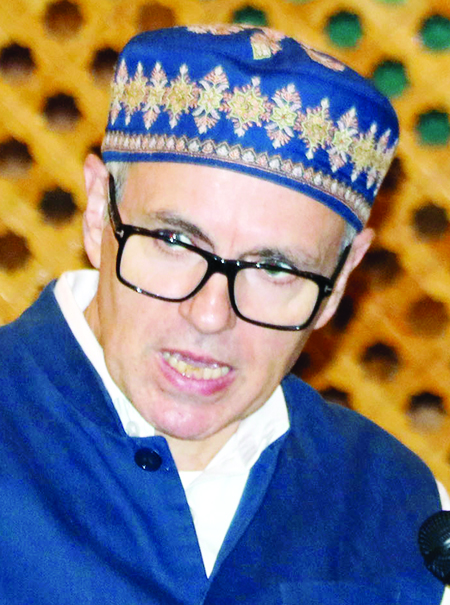
Srinagar, Sep 23: Chief Minister Omar Abdullah on Wednesday said the elected government in the Union Territory has no role in deciding whether books should be banned under the present administrative arrangement, and questioned whether banning books was the way forward in a democracy.
His remarks came a day after the J&K government informed the Legislative Assembly that 21.81 lakh books and publications had been screened, with 4,249 non-banned books withdrawn from circulation and 518 copies of 19 already banned titles also removed. Another 1,752 books were referred for expert examination.
"I have my own views on whether books should be banned or not. But unfortunately, in the current system, the elected government doesn't get to decide these things," Abdullah told reporters.
He said the issue raised a wider question about the role of book bans in a democratic society and indicated that the elected government would review the matter if the administrative arrangement changed.
The Chief Minister also hit back at BJP remarks over the role of National Conference founder Sheikh Mohammad Abdullah during the period preceding the 1947 events. Responding to BJP's allegation that Sheikh Abdullah had acted as a conduit for the British against Maharaja Hari Singh, Abdullah said those who did not participate in the freedom struggle should not lecture others about that period.
He referred to the historical role of the RSS and predecessors of the BJP, while asserting that the contribution and sacrifices of the National Conference in Jammu and Kashmir could not be erased. He also accused the BJP of attempting to distort history. Earlier, Leader of Opposition in the J&K Legislative Assembly Sunil Sharma had alleged that Sheikh Abdullah was part of a British conspiracy against Maharaja Hari Singh and claimed that he had acted at the behest of the British during the 1931 agitation. On the reported differences within the Election Commission of India over electoral-roll revision, Abdullah called for corrective measures by the Centre and the poll panel, saying public confidence in elections was essential for democracy.
"Corrective action needs to be taken somewhere. Otherwise, if people lose faith in elections, what remains of a democracy?" Abdullah said, urging the Election Commission and the Government of India to reflect on the issue.
He was responding to a report in The Indian Express that Election Commiss-ioners Sukhbir Singh Sandhu and Vivek Joshi had reportedly recorded objections on at least 14 occasions over 10 months concerning decisions and orders relating to electoral-roll revision. The reported issues included changes to Form 6, centralisation of electoral-roll database controls and matters concerning addition and deletion of names.
Abdullah said the report raised questions about the functioning of the poll panel and recalled that Jammu and Kashmir had earlier raised concerns over the delimitation exercise. He said if people lost faith in the electoral process, their participation in elections could also be affected.
The Election Commission, however, said on Wednesday that differences of opinion and observations were a normal part of deliberations in a multi-member constitutional body. It maintained that all its orders, including those relating to the Special Intensive Revision, had the approval of all three Election Commis-sioners and carried full legal sanction.
The EC also said that officers of the Commission were authorised to offer suggestions for improving the electoral system.
On Congress leader Rahul Gandhi's allegation of "vote chori" and his contention that manipulation of electoral rolls amounted to an attack on the Constitution, Abdullah said the concern was justified and called for steps to address issues relating to voter inclusion and deletion. He said the credibility of electoral rolls and public confidence in elections were fundamental to the functioning of a democracy.
Share This Story |
|
Comment On This Story |
|
|
|
|