Mere recommendation does not confer right to retrospective promotion: DB



16/10/2026
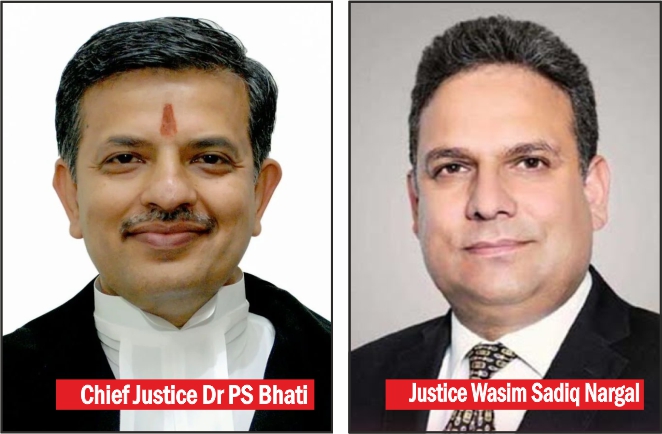
JAMMU, Oct 15: The High Court of Jammu and Kashmir and Ladakh has held that a mere recommendation for out-of-turn promotion does not create an enforceable right to claim retrospective promotion, even if similar benefits have been granted to another employee.
A Division Bench comprising Chief Justice Dr Justice Pushpendra Singh Bhati and Justice Wasim Sadiq Nargal made the observation while allowing a petition filed by the Jammu and Kashmir administration and setting aside a Central Administrative Tribunal (CAT) judgment that had granted retrospective promotional benefits to police officer Nissar Ahmad Mir.
The court held that out-of-turn promotions depend on the facts and circumstances of individual cases and cannot be claimed solely on the ground of parity with another employee.
The dispute arose after Mir was recommended for out-of-turn promotion to the rank of Inspector on operational grounds in 1998. He sought retrospective promotion with effect from June 8, 1998, but was eventually promoted as Inspector on September 29, 2006.
His subsequent claim for retrospective benefits was rejected by the Police Headquarters.
The CAT, Srinagar Bench, subsequently quashed the departmental rejection order and directed the authorities to grant him notional promotion from June 8, 1998, along with monetary benefits from September 29, 2006.
Challenging the Tribunal's judgment dated June 24, 2022, the administration and the Director General of Police approached the High Court, contending that the Tribunal had wrongly extended benefits to Mir on the ground of parity with another police officer, Abdul Khalid Khan.
Ms. Maha Majeed, assisting counsel for Senior Additional Advocate General Mohsin-ul-Showkat Qadiri, appeared for the petitioners, while Advocates Bhat Fayaz and Nighat Amin represented Mir.
After examining the record, the Division Bench observed that a recommendation, even when made by a competent authority, remains part of the decision-making process and does not automatically create a legally enforceable right to promotion from the date of recommendation.
"A recommendation, even if made by the competent authority, does not crystallise into an enforceable or indefeasible right to out-of-turn promotion from the date of such recommendation," the court held.
The Bench further observed that the principle of parity could not be applied mechanically to out-of-turn promotions, as such decisions depend on the circumstances and applicable legal framework of each case.
Referring to the Supreme Court judgment in State of Madhya Pradesh versus Sanjay Shukla, the court reiterated that an employee cannot claim out-of-turn promotion as a matter of right merely because another officer has received similar treatment.
The Bench also took note of Mir's failure to pursue his claim for nearly seven years after the Police Headquarters rejected it in March 2010.
It observed that the Tribunal had failed to properly examine the earlier rejection order, the prolonged delay in pursuing the claim and the material differences between Mir's case and that of the officer with whom he had sought parity.
The court held that the principles of acquiescence and the conduct of litigants were relevant while considering attempts to revive previously rejected service claims. A subsequent benefit granted to another employee, by itself, could not create a fresh enforceable right to retrospective promotion, it added.
Allowing the government's petition, WP(C) No. 2059/2023, the Division Bench set aside the CAT judgment dated June 24, 2022, and restored Police Headquarters Order No. 2607/2021 dated August 26, 2021, rejecting Mir's claim.
However, the court clarified that its decision would not affect Mir's existing promotion to the rank of Inspector with effect from September 29, 2006.
Share This Story |
|
Comment On This Story |
|
|
|
|